
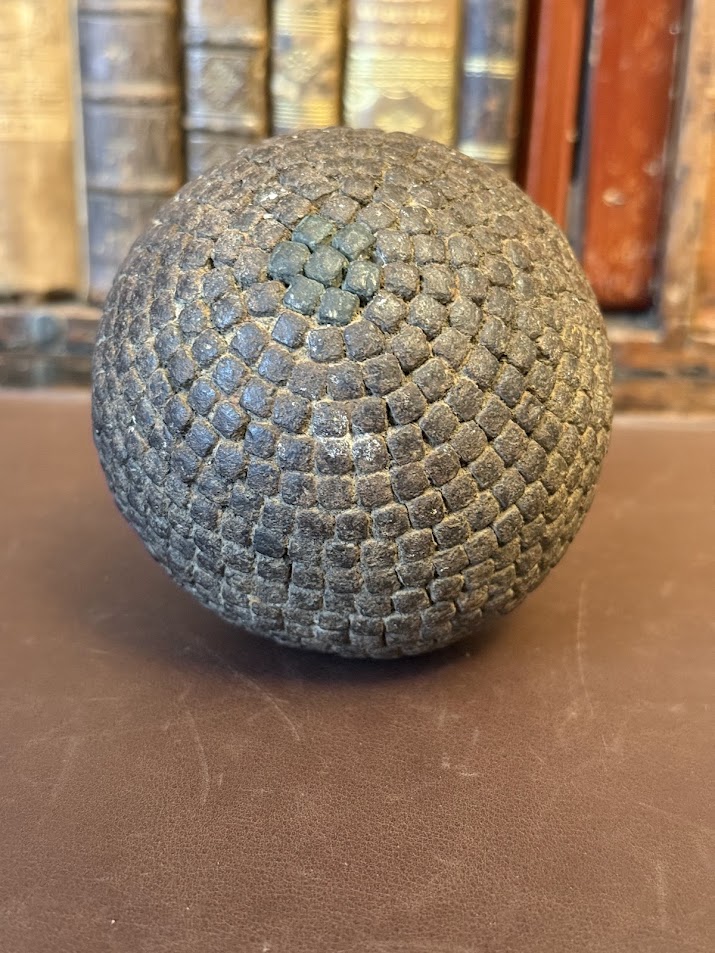

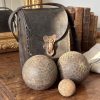

Hold a piece of French history in your hand. Sourced directly from the historic walled city of Carcassonne in Occitanie, this is a magnificent example of a “Boule Cloutée” (nailed ball), the predecessor to the modern metal pétanque ball.
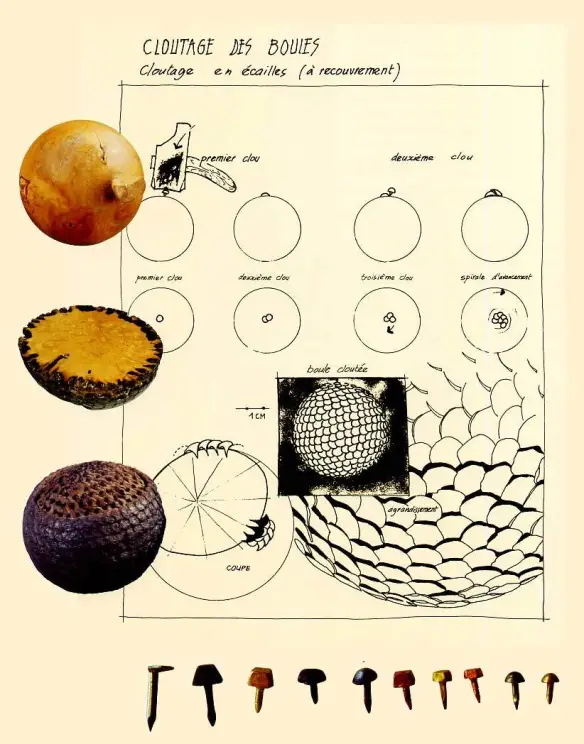
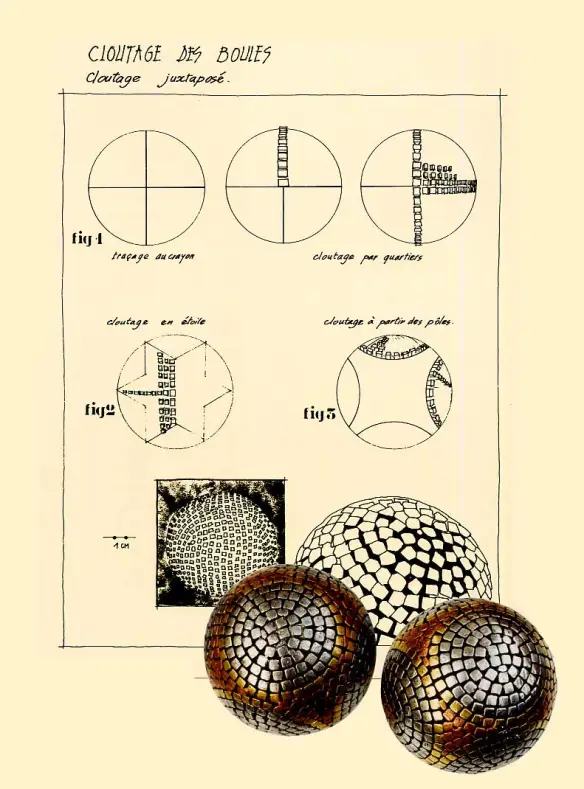
Dating from the late 19th Century (approx. 1860–1900), this heavy, tactile sphere is a work of true craftsmanship. Before the invention of the hollow metal alloy balls we see today, players used balls turned from hard boxwood (buis). To protect the wood from the rocky terrain of Southern France and to add necessary weight, local craftsmen (known as clouteurs) would meticulously hammer hundreds—sometimes thousands—of nails into the wooden core.
This specific example features square-headed hand-forged nails, indicating an earlier manufacture date than the round-headed nails that became common later. The nails have been hammered so closely together that they form a continuous, scale-like “armor” reminiscent of pinecones or snakeskin.
Key Features:
-
Origin: Carcassonne, France.
-
Era: Napoleon III to Belle Époque (Circa 1860–1900).
-
Construction: Boxwood core completely encased in square iron nails.
-
Detail: Note the small cluster of lighter/greenish nails (likely copper or brass) near the top. This was often done intentionally by the owner to distinguish their boule from others during the game.
-
Aesthetic: A stunning decorative object for a library shelf, a heavy paperweight, or a conversation piece for a coffee table.
Historical Context
Long before the game was officially codified as “Pétanque” in La Ciotat in 1910, the French played Jeu Provençal or La Lyonnaise. These games required heavy balls capable of withstanding impact.
The production of these balls was a specific trade. A clouteur would take a root of boxwood, turn it into a sphere, and then begin the laborious process of covering it in iron.
-
The “Square Nail” Era: Square nails (as seen on this piece) were generally used until around the turn of the 20th century. They provided a tighter fit than round nails, creating a nearly solid metal surface.
-
The Decline: By the 1920s, the “Boule Intégrale” (an all-metal bronze/aluminum alloy ball) was invented, rendering the wooden boule cloutée obsolete for competitive play. Today, these nailed balls are highly coveted examples of French Art Populaire (Folk Art).
Condition Report
Condition: Original and Unrestored. This item is sold in its authentic condition to preserve its historical value. The iron nails show a dark, rich oxidation consistent with age. There is no loose rattling; the structure feels perfectly solid. The nails have worn smooth from decades of play on the gravel squares of Southern France, giving the ball a wonderful texture.